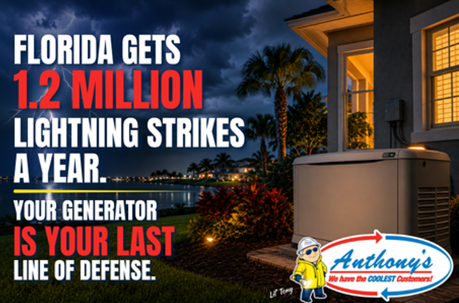
There's a reason locals call it the Lightning Capital of the World. Florida leads every other state in the country when it comes to lightning strikes — averaging approximately 1.2 million cloud-to-ground strikes every single year. And if you've spent more than one summer on the Suncoast, you don't need a statistic to tell you that. You've seen it. You've heard it rattle the windows. You've watched the power blink out in the middle of dinner, or worse, in the middle of a July night when it's 90°F outside and your AC was the only thing standing between your family and a very long, very sweaty evening.
Summer storm season on the Suncoast isn't a maybe. It's a when. The question isn't whether your home will face lightning, power surges, and outages this July — it's whether your home is actually prepared when it does.
At Anthony's Cooling Heating & Electrical, we've been serving families across Sarasota, Bradenton, Palmetto, and Manatee County for nearly 40 years. We're an authorized Generac dealer, and we've seen what Florida summers do to homes that are prepared and homes that aren't. The difference is significant. Here's what every Suncoast homeowner needs to understand before the next storm rolls in.
Lightning Doesn't Have to Hit Your Home to Damage It
This is the part that surprises most people. You don't need a direct strike on your roof for a lightning event to cause real damage inside your home. In fact, most lightning-related electrical damage on the Suncoast comes from indirect strikes — lightning hitting a utility pole down the street, a transformer in your neighborhood, or the ground near a power line — and sending a massive voltage spike traveling through the electrical grid directly into your home.
That surge moves fast, and it moves silently. It travels through your wiring and seeks out anything connected to it. Your air conditioner's control board. Your refrigerator. Your TV. Your router. Your HVAC system's capacitors and compressor. In some cases, the damage is immediate and obvious — the system just stops. More often, it's cumulative. Each surge degrades the sensitive electronics inside your appliances and HVAC equipment a little more, until one day something fails and you're left wondering why a system that was "working fine" suddenly isn't.
We see this pattern every summer in Bradenton and Sarasota. Homeowners replace AC control boards once, twice, sometimes three times before someone finally asks the right question: is there something causing this? The answer, almost every time, is unprotected surge exposure. Florida's power grid faces relentless pressure during summer months — between the demand of millions of air conditioners running simultaneously and the near-daily storm activity, voltage fluctuations are constant. Your home's electrical system is absorbing that stress whether you know it or not.
What you can do about surge damage: Whole-home surge protection, installed at your electrical panel by a licensed electrician, intercepts excess voltage before it reaches your circuits and appliances. A plug-in power strip is not the same thing — it protects whatever is plugged into it and nothing else. Your HVAC system, hardwired appliances, and the rest of your home's wiring have no protection from a standard surge strip. If your home doesn't have a whole-home surge protector installed at the panel, that's a conversation worth having.
What a Summer Power Outage Actually Means in Sarasota and Bradenton
Let's talk about the other side of the storm: the full outage. The lights go out, the AC goes quiet, and suddenly your home in July becomes a very different place.
Interior temperatures in Southwest Florida can rise 10 to 15 degrees within the first two hours of losing power on a July afternoon. By hour four, without any cooling, a home that was 76°F can approach 90°F or higher. For families with young children, elderly parents, or anyone with a medical condition that requires climate control or refrigerated medication, a summer power outage isn't just uncomfortable — it's a genuine health concern.
And outages on the Suncoast during storm season aren't resolve quickly . Depending on the severity of the storm and how many homes are affected, FPL and TECO restoration can take anywhere from a few hours to several days. After major storms in Manatee and Sarasota counties, we've seen neighborhoods go without power for 48 to 72 hours. That's a long time to wait out the Florida heat and a hurricane can see you without power for weeks.
This is the situation a standby generator is built for. Not a camping inconvenience. An actual emergency that affects your family's safety and comfort in the middle of summer.
Portable Generator or Standby Generator — What's the Real Difference?
If you already have a portable generator in your garage, you're ahead of a lot of your neighbors. But it's worth being honest about what a portable generator can and can't do — because there's a meaningful difference between portable and standby, and it matters in a real storm.
Portable generators require you to drag them outside, add fuel, manually start them, and run extension cords or a transfer switch to your appliances. They run on gasoline, which means you need to have fuel stored and on hand before a storm — and if you're in the middle of a widespread outage, every gas station in the area may have a line around the block or be out of fuel entirely. They also produce carbon monoxide, which means they can never be run inside or in a garage. And if the storm hits at 2 AM, "go outside in the rain and manually start the generator" is the reality.
Standby generators — like the Generac systems that Anthony's installs throughout Manatee and Sarasota counties — work completely differently. They're permanently installed outside your home, connected directly to your electrical panel, and fueled by natural gas or propane. When your power goes out, the automatic transfer switch detects the outage and the generator starts on its own — typically within 10 seconds. You don't have to do anything. Your AC keeps running. Your refrigerator stays cold. Your lights stay on. Most homeowners tell us they barely notice the transition.
For families on the Suncoast who want real peace of mind during hurricane season and summer storm season, a standby generator isn't a luxury — it's infrastructure. And as an authorized Generac dealer, Anthony's handles the entire process: sizing the right system for your home, obtaining permits, installing the generator and transfer switch, and making sure everything is tested and working before we leave.
Your Generator Is Only as Ready as Its Last Service
Here's the part most generator owners don't want to hear: having a standby generator installed is only half the equation. A generator that hasn't been properly maintained can fail at exactly the moment you need it most — and that moment is almost always in the middle of a storm.
Think about what happens to a standby generator between hurricane seasons. It may run its automatic weekly self-test, but that's a brief, low-load exercise. It isn't designed to catch the kinds of issues that develop over months of sitting: oil that has degraded and lost its protective properties, a battery that has slowly discharged to the point it can no longer reliably start the unit, fuel system components that have gummed up from stale gas, or a transfer switch that has developed connection issues. None of these problems announce themselves. They just wait.
And then the storm comes, the grid goes down, and the generator doesn't start.
We hear this story every summer in Bradenton and Sarasota. Homeowners who invested in a quality Generac system, but skipped the annual maintenance visit, find out their generator has a problem at the worst possible time. A professional generator maintenance visit — done before storm season peaks, not after — catches all of these issues while there's still time to fix them. It's not a complicated visit. But it's the difference between a generator that works and a generator that looks like it works.
A professional generator maintenance visit from Anthony's covers:
- Oil and filter service to restore proper engine lubrication
- Battery load testing to confirm reliable starting power
- Fuel system inspection to check for degradation or contamination
- Transfer switch operation test to confirm automatic failover works correctly
- Full load test to verify the generator can handle your home's actual power demand
- Visual inspection of all connections, exhaust, and mounting
If it's been more than a year since your generator was last serviced — or if you've never had it professionally maintained since installation — it needs to be looked at before the next major storm, not after.
July Is the Right Time. Not August. Not After the Storm.
We say this every year, and we mean it: the best time to service your generator is before you need it. Once a storm is in the forecast, service slots fill up fast. Once a storm has passed and thousands of homes lose power, everyone is calling at the same time. The homeowners who are prepared are the ones who made a phone call in early July, had their system serviced and tested, and then sat comfortably in a cool home while the storm did its worst outside.
That's exactly the situation we want for every family on the Suncoast. Not a scramble. Not a regret. Just a prepared home and a generator that starts the moment it's asked to.
As an authorized Generac dealer serving Palmetto, Bradenton, Sarasota, and the surrounding communities, Anthony's has the experience, the training, and the parts on hand to service your system correctly. Our technicians are licensed, bonded, and insured, and they don't work on commission — which means when we look at your generator, we'll tell you exactly what it needs and nothing it doesn't.
You Don't Need New Until We Say You Do.® That applies to generators too. If yours is in good shape with a service and a tune-up, that's what we'll tell you. If it needs something more, we'll explain exactly why and let you make the decision.
What Anthony's Is Doing About It This July
This month, Anthony's is offering $75 off generator maintenance for Suncoast homeowners across Sarasota, Bradenton, Palmetto, and Manatee County. Whether you have a Generac unit that was installed recently or one that's been running for several seasons, now is the time to get it serviced and confirmed ready for the rest of storm season.
Don't wait for the next power outage to find out where your generator stands.
📌 Code: GenMaint · Expires 7/31/26 · Call (941) 347-0779
Not sure if your generator is due for service, or thinking about a standby generator for the first time? Call us. We'll have an honest conversation about your home, your situation, and what makes sense — no pressure, no sales pitch. Just the straight answer, from a team that's been doing this on the Suncoast for nearly 40 years.
(941) 347-0779 · AnthonysAirConditioning.com/Specials · Available 24/7
You Don't Need New Until We Say You Do.®