If your air conditioner seems to run constantly but your home never quite gets comfortable, your attic might be the reason why.
Here in the Bradenton, Palmetto, Sarasota, Lakewood Ranch, Parrish, Southern Hillsborough and Pinellas area, June means one thing: it is hot, it is humid, and your AC is working overtime. But what many homeowners do not realize is that the temperature inside their attic plays a major role in how hard their HVAC system has to work — and how much they pay every month on their energy bill.
Let us break it down.
Florida Heat and Humidity: A Challenge Unlike Any Other
Florida summers are not your average warm weather. We are talking about outdoor temperatures that regularly hit the upper 90s, combined with humidity levels that make it feel even hotter. That heat does not just come through your windows and doors — a significant amount of it enters your home from above, straight through your attic.
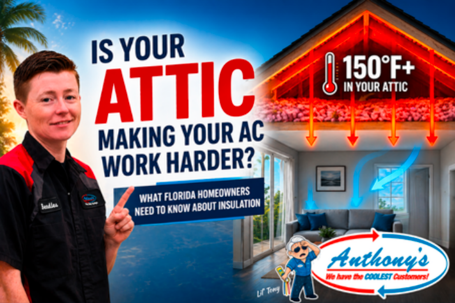
In a poorly insulated attic, temperatures can easily reach 130°F to 150°F during a Florida summer. That extreme heat radiates down through your ceiling and into your living space, forcing your air conditioner to work much harder just to maintain a comfortable temperature.
The result? Higher energy bills, more wear and tear on your HVAC system, and a home that never quite cools down the way it should.
Does Your Roof Type, Color, or Style Affect Your Attic Temperature?
Absolutely — and this is something most homeowners never think about.
Roof Color
The color of your roof has a direct impact on how much heat your attic absorbs. Darker roofing materials — like charcoal or dark brown shingles — absorb significantly more solar heat than lighter-colored roofs. In Florida's intense sun, a dark roof can make your attic measurably hotter than a home with a light gray or white roof.
Roof Material
- Asphalt shingles are the most common roof type in Florida, and they absorb and retain heat throughout the day. Without proper insulation beneath them, that heat transfers directly into your attic.
- Metal roofs actually reflect more solar energy than asphalt, which can help reduce heat gain — but attic insulation is still essential to keep that heat from radiating down into your living space.
- Tile roofs (concrete or clay) are common in our area and offer slightly better airflow between the tiles and the roof deck, but they still require adequate attic insulation to perform well.
Roof Style and Pitch
The shape and pitch of your roof also matter. A steeply pitched roof creates a larger attic space, which can trap more hot air. A low-slope or flat roof has a smaller attic but can be more difficult to insulate properly. In either case, the right insulation is what keeps that heat where it belongs — outside your home.
How Poor Insulation Affects Your HVAC System
When your attic is superheated and your insulation is thin, outdated, or missing, your air conditioner is fighting a battle it cannot win.
Here is what happens:
Your AC runs longer. Instead of cycling on and off normally, your system stays on for extended periods trying to overcome the heat pouring in from above. This drives up your energy bill and puts unnecessary strain on your equipment.
Your system ages faster. Think of your AC like a car — it is not the years that add up, it is the miles. The longer your system runs, the more hours it accumulates on compressors, motors, and other components. More run hours means more wear, and more wear means more frequent repairs and a shorter system lifespan.
Your home stays uncomfortable. Even with the AC running, rooms near the ceiling — or second-floor rooms in two-story homes — can feel noticeably warmer when attic insulation is lacking.
Humidity becomes harder to control. In Florida, humidity is just as much a comfort issue as temperature. When heat continuously seeps into your home, your AC has to work harder to remove moisture from the air as well as cool it down.
How Proper Insulation Can Save You Money
Here is the good news: improving your attic insulation is one of the most cost-effective investments a Florida homeowner can make.
When your attic is properly insulated, your HVAC system does not have to work as hard. That means:
- Lower monthly energy bills. A well-insulated home can meaningfully reduce what you spend running your AC — a real difference over the long Florida summer months.
- More consistent indoor temperatures. Your home stays cooler, more evenly, without your AC constantly playing catch-up.
- Less wear on your HVAC system. Fewer run hours means less strain on your equipment, which can extend its life and reduce the need for repairs.
- A more comfortable home year-round. Insulation does not just keep heat out in summer — it helps keep conditioned air inside, making your home more comfortable in every season.
Blown-In Insulation: A Smart Solution for Florida Attics
Not all insulation is created equal — and in Florida's climate, the type of insulation you choose matters.
At Anthony's Cooling, Heating & Electrical, we install Owens Corning blown-in insulation, and there is a reason we trust this product for our customers' homes.
Owens Corning AttiCat® PINK® Blown-In Fiberglass Insulation is specifically designed to deliver excellent thermal performance and is a great fit for Florida attics. Here is why it stands out:
It fills every gap. Unlike batt or roll insulation that has to be cut and fitted, blown-in insulation is literally blown into your attic space. It fills around beams, joists, and any irregular areas — covering every nook where heat could sneak through.
It resists moisture and mold. Florida's humidity is relentless. Owens Corning's fiberglass blown-in insulation is resistant to moisture, mold, and mildew growth — a critical advantage in our climate.
It does not settle over time. One of the concerns with some insulation products is that they compress or settle, reducing their effectiveness. Owens Corning blown-in fiberglass maintains its thermal performance and does not lose its insulating power.
It is formaldehyde-free. Owens Corning AttiCat insulation is validated formaldehyde-free, making it a healthier choice for your home and your family.
It is Energy Star compliant. That means the product meets the standards set by the Department of Energy — giving you confidence that your investment is backed by real performance standards.
June Special: Save Up to 20% on Blown-In Owens Corning Insulation
This June, Anthony's is making it even easier to protect your home and your HVAC system.
Save up to 20% on Blown-In Owens Corning Insulation
Limit 1 coupon per household. Restrictions may apply. Residential customers only. Coupon must be redeemed on day of purchase. Expires 6/30/26.
There is no better time to upgrade your attic insulation than before the peak of Florida's summer heat. Give us a call or visit our Specials page to take advantage of this offer before it expires.
Not Sure What Your Attic Needs? We Can Help.
At Anthony's, we believe in giving homeowners honest answers — not upsells. If you are unsure whether your attic insulation is up to the job, our team can take a look and give you a straightforward assessment of what your home needs.
As we always say: You Don't Need New Until We Say You Do!
But when it comes to insulation in a Florida home, the right upgrade can make a real difference — in your comfort, your energy bill, and the lifespan of your HVAC system.
Ready to find out if your attic insulation is working as hard as your AC? Contact Anthony's Cooling, Heating & Electrical today to schedule a visit. 📞 (941) 347-0779 🌐 anthonysairconditioning.com